





A Date, an Award Letter, an Asset Sale: Q4's Four Upstream Signals for Wellhead Buyers
2026-10-12
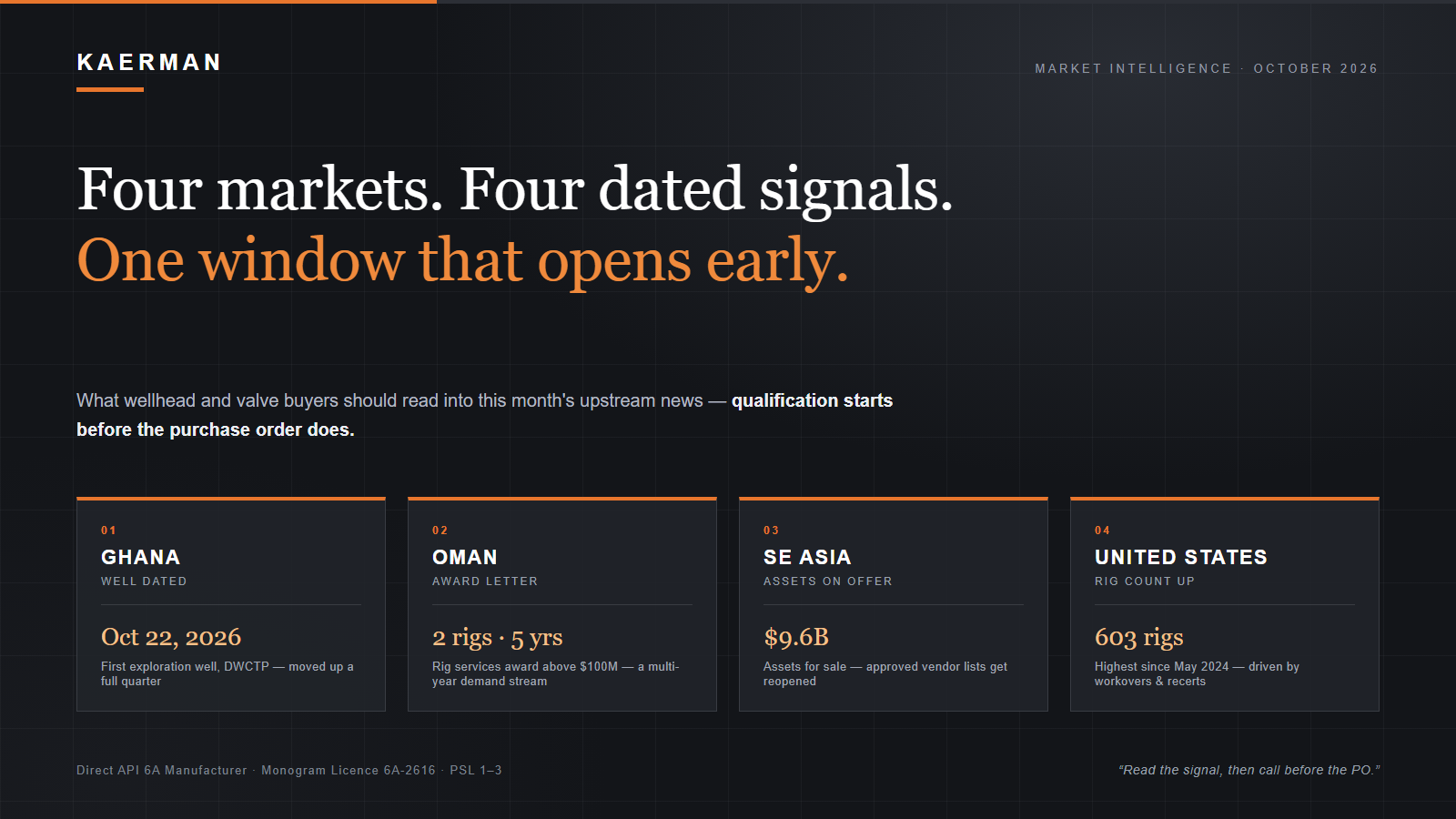
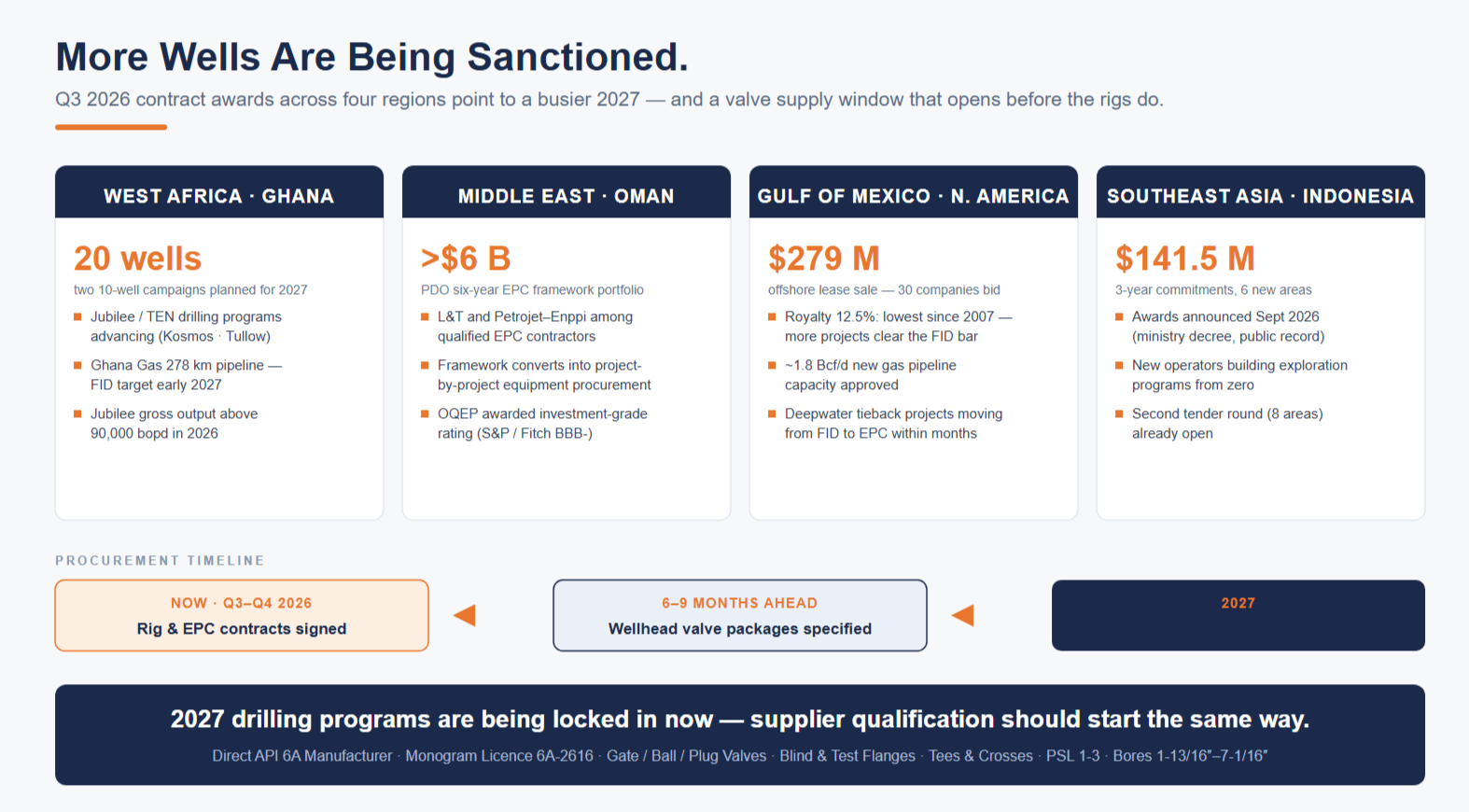
In Ghana, GOIL Upstream has set 22 October 2026 as the target for the first exploration well on the Deepwater Cape Three Points block, according to a statement by its managing director to a parliamentary oversight committee, reported by local energy press. The programme was brought forward from the first quarter of 2027 after a drilling vessel became available earlier than expected — freed up when another operator deferred one of its planned wells. A frontier block moving from "next year" to "this month" in a single quarter is a reminder that upstream windows move in both directions, and usually faster than a supplier's qualification cycle. In Oman, Great Wall Drilling has received a letter of award from Medco covering a five-year drilling services programme of two rigs at the Karim Small Fields, valued at more than $100 million, according to company announcements. Medco operates the field under a service arrangement with Petroleum Development Oman. The award is at the letter-of-award stage and the formal contract has not been signed; no start date and no well count were disclosed. A two-rig, five-year commitment is nonetheless the kind of programme that generates a steady, multi-year stream of wellhead and spare-part requirements rather than a single tender. In Southeast Asia, Rystad Energy reported on 5 October that around $9.6 billion of upstream assets are on offer across the region through 2027, spread over nearly 45 production-sharing contracts, and described the deal market as shifting "from exits to strategic entry." Independents holding pre-final-investment-decision discoveries need capital, and national oil companies are positioned as the natural buyers. Roughly 72% of the resources on offer sit before final investment decision. The practical consequence is a supply chain that is being rebuilt: as blocks change hands, approved vendor lists are reopened, and the window for joining them is often short. In North America, Devon Energy agreed on 8 October to sell its Eagle Ford assets to Crescent Energy for $4.2 billion in cash, transferring about 90,000 net acres and roughly 68,000 barrels of oil equivalent per day. Crescent said it expects to keep rig activity at about the same level. Demand in this segment does not follow single project awards: the US rig count rose five to 603 in the week to 9 October, its highest since May 2024, with the Permian at 274 and the Eagle Ford at 49. Parts demand here moves with replenishment and workover cycles. Read together, the four markets sit at four different stages — an exploration well pulled forward, a multi-year drilling award, a wave of asset sales, and steady rig activity. The common thread is timing: valves and wellhead components are specified during contractor procurement or six to nine months ahead of a drilling programme, which means qualification starts well before the purchase order does. For mid-size buyers — distributors, wellhead assemblers and workover operators — the practical question is capacity and documentation, not price alone. We are Monogram Licence 6A-2616 (verifiable at api.org/compositelist), covering gate, ball and plug valves, blind and test flanges, and tees and crosses at PSL 1–3, in bores from 1-13/16" to 7-1/16", with capacity of around 1,000 valves per month and a minimum order of one piece.